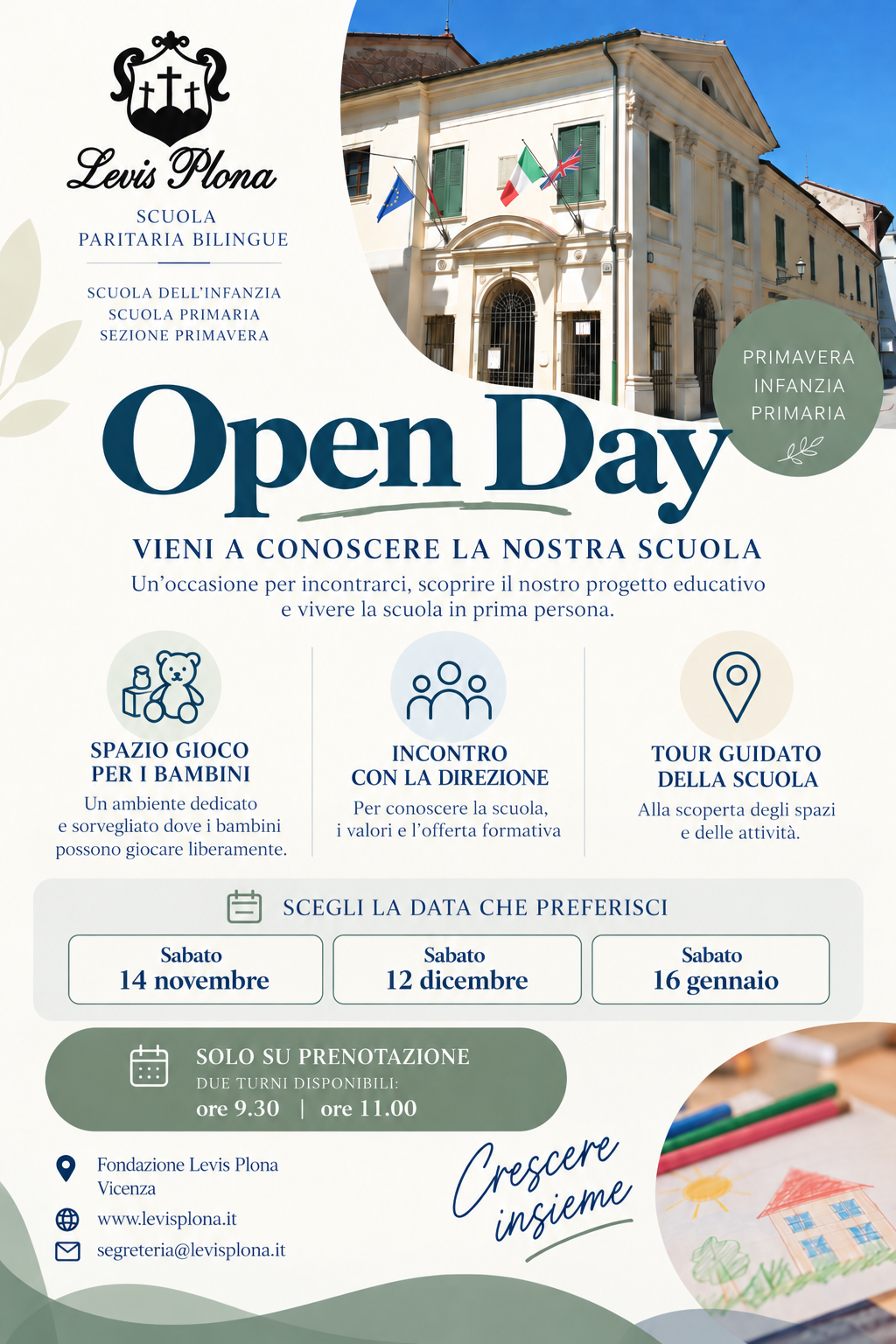
The School
Educational Aims
The School intends, in collaboration with families:
- To implement a cultural project aimed at the integral education of the person, based on Christian values and constitutional principles;
- To promote the growth of all, with full respect for each child so that everyone can begin to build their own life project
- To develop basic cultural competencies in various disciplines
- To develop social and civic competencies of an international nature through bilingualism (Italian-English) from Early Years, promoting cooperation
- To enhance musical, motor, and technological competencies
Educational and Didactic Planning
Educational and didactic planning refers to:
- The National Guidelines for the curriculum of Early Years and the first cycle of education and related ministerial documents
- The Recommendations of the European Parliament (2006, 2018)
- The educational aims, priority educational objectives, and guidelines for the school’s educational action, which is inspired by Christian values
- The priorities identified through institutional self-evaluation (RAV)
and is implemented in the School Curriculum and in the annual planning of each class team.
Three-Year Educational Plan
Through its Three-Year Educational Plan (PTOF), Levis Plona Early Years and Primary School aims to guarantee all pupils the exercise of the right to education and educational success, to the best realization of themselves in relation to individual characteristics, according to principles of equity and equal opportunities. Pupils are introduced to mastery of basic literacies and to acquire experiences, knowledge, skills, and competencies to face, with the necessary tools, the continuation of their studies and above all the challenges of life through the use of critical and reflective thinking and the capacity for responsible choices.
Alongside cultural education, the PTOF develops its activities in pursuit of another essential aim: education for active, aware, responsible, democratic, and supportive citizenship that fosters in pupils respect for themselves and others.
From the reflections and evaluations developed in the Collegial Bodies regarding academic outcomes, the self-evaluation of the previous PTOF, observations on the current cultural and social context, and in light of the principles present in the Educational Project of the recognized school Fondazione Levis Plona, the strategic choices for the three-year period are identified.
The improvement plan (PdM) is a pathway that plans the achievement of targets connected to the identified priorities. It is prepared annually by teachers and constantly monitored.
The Values of Our School
Levis Plona Primary and Early Years School is a recognized public school with Christian inspiration.
For this reason, its educational and formative role is also realized in the promotion of certain universal values that Christians can consider as deriving from their religious faith.
Parents who enroll their children in this school must therefore know that these values are openly professed here. Therefore, the family education of pupils cannot be inspired by values that explicitly conflict with these.
They are in particular the following:
- The value of human life and other living beings, for this reason a positive attitude toward everything that surrounds humanity is promoted. Respect for the environment and its balance are the natural consequence.
- Freedom as both premise and consequence of the dignity of every person. This freedom must be safeguarded from all oppression, but also from any dependence on people and substances that may limit or damage it.
- Mutual acceptance regardless of any personal condition (age, gender, ethnicity, religion, or other); open and respectful dialogue; the will to resolve disagreements and conflicts, the practice of forgiveness of offenses and the rejection of violence; the will to build deep and lasting relationships. These are all conditions for positive thinking.
- The rejection of consumerism, of the exploitation of one person by another, of the promotion of profit as the sole parameter of economic evaluation; the promotion of every person and especially of the weakest and least advantaged. All contribute to giving true meaning to life.
Finally, the school proposes to pupils objectives of self-improvement, but does not encourage competitiveness for its own sake among pupils.